 Fairy Tales, Stories & Games for Kids Fairy Tales, Stories & Games for Kids
How does wind form?
- The Sun at work: land, water and forests heat at different speeds. Dark ground and sand warm faster; water warms slower.
- Warm vs cool air: warm air rises; cooler air rushes in to take its place. That rushing air is the wind.
- Air pressure: warmer areas tend to have lower pressure, cooler areas higher pressure. Air flows from high to low pressure.
Why is wind sometimes strong and sometimes gentle?
The bigger the differences in temperature and pressure, the faster the air moves. Near coasts you may feel a sea breeze by day and a land breeze by night. At midday, sunshine can make winds livelier; after sunset, they often calm.
Make the invisible “visible”
- Leaf test: drop a light leaf — which way does it travel?
- Ribbon watcher: hang a thin ribbon; note the angle and direction during the day.
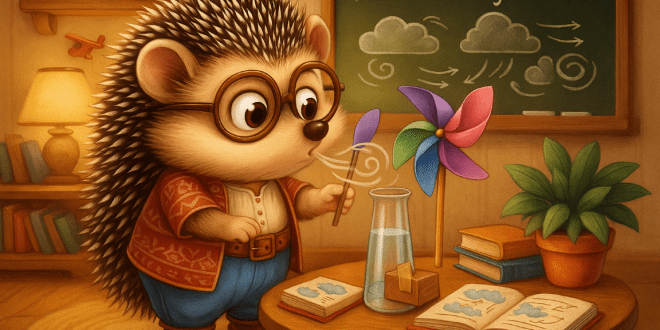
- Paper sail: craft a tiny pinwheel or paper boat and watch the wind push it.
Simple home experiments (with adult help)
- Warm vs cool: blow the same soap bubbles over a cup of warm water and a cup of cool water; you’ll notice livelier motion over warmth — heat stirs the air.
- DIY wind vane: put a paper triangle on a stick outdoors; record direction each hour to see daily changes.
Wind safety tips
- Avoid standing under old, tall trees in strong wind.
- Keep kites and flying toys away from power lines.
- In dusty wind, cover mouth and nose with a scarf or mask.
Story note
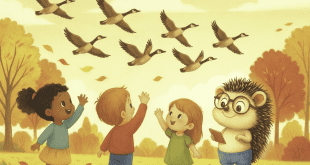
Nuk released a leaf — “whoosh!” — and learned that even if he couldn’t catch the wind, he could see its work: carrying leaves, waving grass and cooling cheeks. Wind is air’s gentle dance.
Quick FAQs
What is wind? Moving air. Why does it happen? Uneven heating by the Sun and pressure differences. Why does it change direction? Daily heating/cooling and different surfaces guide the flow.
Takeaway for kids
Listen to the wind in the trees, watch leaves travel, build tiny sails. Exploring answers “What is wind?” not only with words but with experiments!
 Explore more STEM posts here.