 Fairy Tales, Stories & Games for Kids Fairy Tales, Stories & Games for Kids
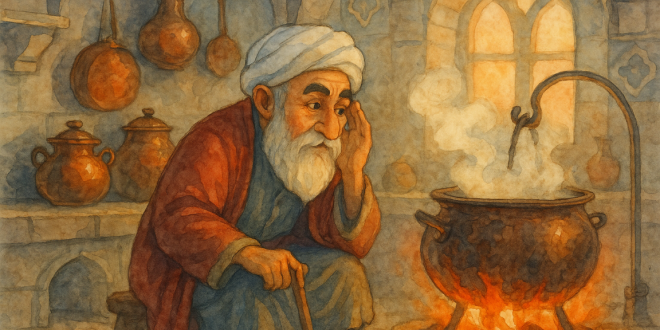
Bilici Baba tale — The Secret of the Pot and the Wise Girl
Bilici Baba tale is a classic folk story from Azerbaijani tradition. In this Bilici Baba tale, a proud king tests a wise elder with a strange riddle about a boiling pot and beans. Searching for the answer, the elder meets a woodcutter and his wise daughter, whose clear thinking unlocks the truth. Children learn that careful observation, logic, and humility outshine pride and trickery.

Original Bilici Baba tale
Once upon a time there was an old man. People called him Bilici Baba — the Knowing Grandfather.
Bilici Baba served in the king’s palace. Whenever the king planned something harmful against the people, Bilici Baba learned of it and spoiled the plan before it could be carried out. For this reason the king disliked him and tried to drive him out of the palace. He tried many pretexts and set many traps, yet none succeeded. That only made the king angrier, and he kept weaving new snares.
One day the foolish king pointed to a cauldron boiling over the fire and said to Bilici Baba:
— They say you know every secret, even the language of lifeless things. Tell me, what are the boiling beans and the pot talking about?
— If you learn their conversation and tell me, I will reward you. If you cannot, blame your fate! I give you three days.
Bilici Baba said nothing. To learn the secret of the boiling beans, he left the palace and walked through villages and fields. On the road he met a woodcutter and joined him as a companion. When they passed a graveyard, they saw a burial taking place.
Pointing to the burial, Bilici Baba asked the woodcutter:
— Are they burying this poor one dead or alive?
Though the question seemed strange, the woodcutter replied:
— Do people bury the living? Of course he is dead.
Their path then led by a field of wheat.
Bilici Baba pointed to the heads of grain and asked:
— Tell me, has this field been harvested or not?
After this odd question, the woodcutter thought his companion simple-minded and stopped answering him, only shrugging and walking on.
Toward sunset the woodcutter reached his hut and invited the traveler to stay the night.
After the guest rested, the woodcutter told his daughter about the strange questions the traveler had asked along the way.
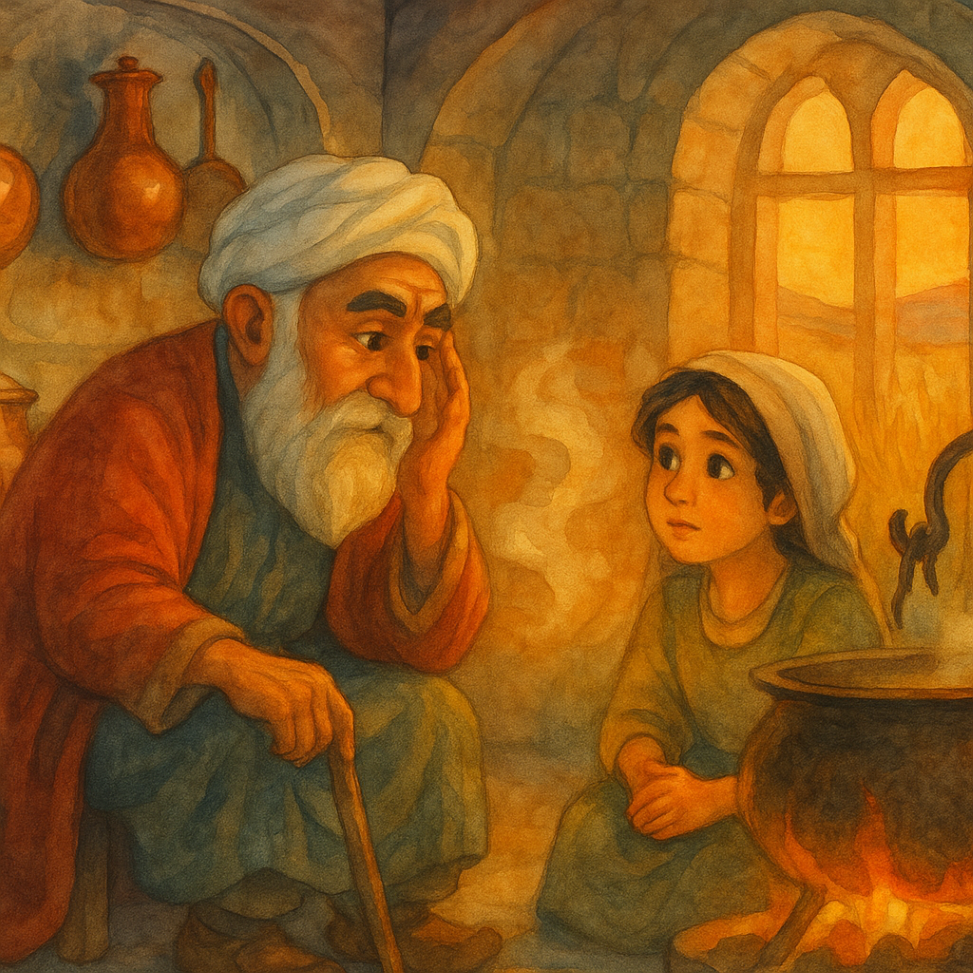 The girl smiled and said:
— Nothing is strange, father. The guest’s remarks are to the point. He meant: if the buried man has children, then he is “buried alive” — because his name and bloodline live on. If he has no children, he is buried dead.
Her explanation pleased her father.
— What else did he say, father?
— Seeing that I was tired and limping a little, he advised me to enter the forest and find a third leg for myself.
— That too is meaningful. A walking stick is a third leg for the weary.
— What else did he ask?
— When we passed the field of grain he stopped and asked whether the field had been harvested or not.
— Quite right. Since the owner has already sold all the grain on credit, the field is as good as harvested.
The woodcutter now knew their guest was not a fool but a wise man and wished to talk with him, yet it was late and he did not disturb him.
In truth, the guest was not asleep. Lying on the bed, he wondered what answer he could give the king in the morning. The talk of the father and daughter drew him out of his thoughts; he listened with attention. When they finished, Bilici Baba said to himself: “If even this clever girl cannot answer the king’s riddle, then all is lost.”
At dawn the guest told his host what had happened and asked the girl for help. He told her the riddle given by the king. The girl said:
— Nothing could be easier. The answer is clear as day. Go and tell the king: the beans boiling in the pot threaten the fire, saying, “Do not burn me, or I will boil over and put you out.”
Bilici Baba tale — context and situation
This Bilici Baba tale begins with a proud monarch who wants to disgrace the wise elder. The riddle — “What do the boiling beans and the pot say?” — is meant to be impossible. Yet the Bilici Baba tale shows how answers can hide in daily life: in a burial, in a field of grain, and in the simple tool an old man needs to walk. The woodcutter’s daughter reads these signs with calm logic and turns mockery into wisdom.
Bilici Baba tale analysis — what happens and why
- Reading signs: The burial, the “third leg,” and the “already sold grain” reveal a way of thinking that links observation to meaning.
- Solving the metaphor: Beans, pot, and fire form a tiny world of forces: the fire burns; the pot conducts heat; the beans threaten to foam and overflow. The clever answer mirrors the real kitchen: overflow can extinguish flame.
- Power vs. wisdom: The king’s power sets the riddle; the village girl’s wisdom resolves it. The Bilici Baba tale honors quiet intelligence over noisy authority.
Bilici Baba tale: the woodcutter and the daughter’s logic
The woodcutter represents honest work; the daughter, precise reasoning. She translates life into logic: lineage makes a person “live on”; a stick is a “third leg”; a field sold on credit is “already harvested.” Her reasoning gives Bilici Baba the key. In many folk stories, wisdom appears where we least expect it — not only in palaces but in humble homes.

Bilici Baba tale — morals, values, and classroom ideas
- Observation leads to insight: Look closely; connect small clues to larger ideas.
- Logic clarifies language: Riddles often use metaphors; test them against real life.
- Humility over pride: True authority listens and learns.
- Value of everyday wisdom: A village girl can solve what a palace cannot.
Classroom prompts: Ask students to list three everyday objects and invent a riddle that those objects could “say.” Then swap riddles and solve them using observation, as in the Bilici Baba tale.
Word explanations (Glossary)
- Bilici: “Knowing” or “wise”; Bilici Baba means “Grandfather of Knowledge.”
- Riddle: A puzzle that hides meaning in metaphor or wordplay.</ li>
- Third leg: A poetic way to describe a walking stick.
- Harvested: Grain cut and gathered; here, also “as good as harvested” because it was sold in advance.
FAQ — Frequently Asked Questions
What is the main lesson of the Bilici Baba tale?
That careful observation and clear logic can defeat pride and trickery. The king’s test is overcome by wisdom found in everyday life.
Why does the girl’s answer make sense?
Because it matches reality: a pot can boil over; liquid can put out a flame. The metaphor is solved by common sense.
How can we use the Bilici Baba tale with children?
Invite children to notice small details in their surroundings and turn them into clues. Let them craft and solve riddles using objects in the kitchen or classroom.
 Read more adventures of Kirpi Nuk here.